Become an SRE Engineer: Essential Skills and Training

September 21, 2026 · 18 reads
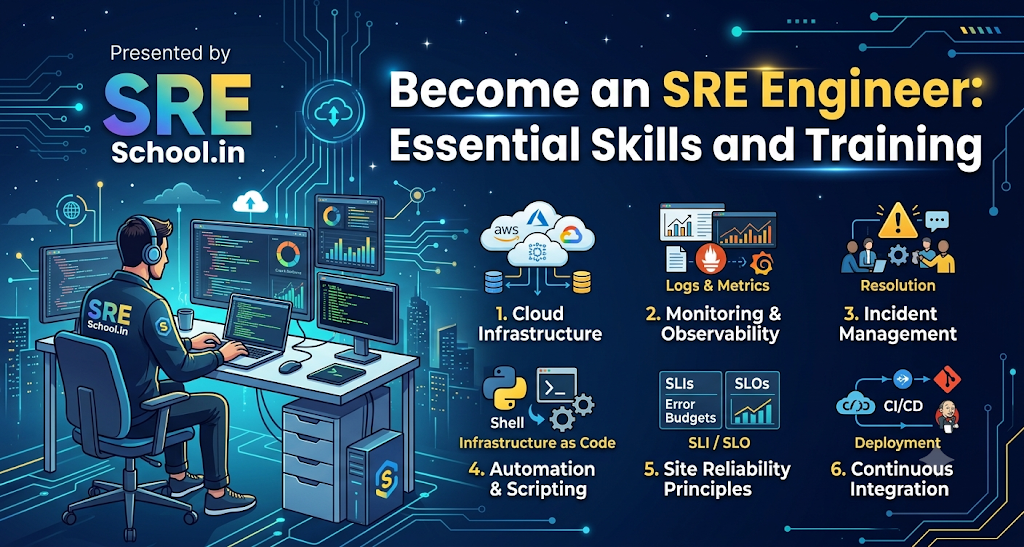
Introduction
An application works normally during testing, but it fails when traffic increases. Latency rises, error rates jump, alerts start firing, and engineers need to find the root cause quickly. Production environments are unpredictable. When systems scale up, hidden issues emerge.
Site Reliability Engineering helps teams build scalable and highly available software systems. Instead of treating operations as a manual chore, SRE applies software engineering principles to infrastructure and operational challenges.
Engineers need structured reliability skills to handle complex distributed systems. Quality SRE Training helps professionals develop these practical abilities, teaching them how to monitor, automate, and improve production systems.
What is Site Reliability Engineering?
Site Reliability Engineering is a discipline that incorporates aspects of software engineering and applies them to infrastructure and operations. The primary goal is to create ultra-scalable and highly reliable software systems.
Historically, software development teams wrote code and threw it over the wall to operations teams to run. This created friction. Developers wanted rapid change. Operations teams wanted stability. SRE bridges this gap.
An SRE approach focuses on core system attributes:
- Reliability: The probability that a system will perform its intended function without failure for a specified time.
- Availability: The percentage of time a system remains operational and accessible to users.
- Performance: How fast a system responds to user requests.
- Scalability: The ability of a system to handle growing workloads by adding resources.
- Automation: Replacing manual tasks with software solutions.
Consider a practical example. A team notices that engineers spend hours fixing the same deployment problem every week. An SRE approach looks for ways to automate the deployment script or redesign the build pipeline so the failure cannot happen again. SRE treats operations as a software problem.
What Does an SRE Engineer Do?
The role of an SRE engineer is diverse. Day-to-day work blends software development with system administration.
Common responsibilities include:
- Monitoring systems: Keeping watch over production health metrics.
- Managing alerts: Tuning notification rules to catch real problems without creating noise.
- Troubleshooting production issues: Investigating root causes during outages.
- Incident response: Restoring service quickly when things break.
- Automation: Writing scripts or code to eliminate manual toil.
- Capacity planning: Ensuring infrastructure can handle future traffic growth.
- Reliability improvements: Refactoring fragile components.
- Deployment support: Helping teams release new code safely.
- Infrastructure management: Provisioning cloud resources through code.
- Performance monitoring: Tracking latency and resource bottlenecks.
- On-call operations: Responding to pages during and after business hours.
Job descriptions vary between organizations. A startup SRE might focus heavily on cloud infrastructure and CI/CD pipelines. An SRE at a large tech enterprise might build internal observability platforms and automated failover tools.
Why System Reliability Matters
Reliable systems matter to both users and engineering teams. When software fails, the impact is immediate.
Downtime disrupts business operations. If a payment service becomes unavailable, users cannot complete transactions. If a streaming app fails, users abandon the platform.
Slow applications frustrate users just as much as complete outages. Failed requests, slow page loads, and deployment problems degrade the user experience.
For engineering teams, unstable systems cause high operational toil. If engineers spend all their time putting out fires, they have no time to build new features.
Proactive reliability engineering reduces outages. When monitoring detects failures early, engineers respond faster, minimizing downtime and protecting user trust.
SLI, SLO, SLA, and Error Budgets
SRE relies on clear metrics to measure system health. Teams define targets using specific reliability terms.
- SLI (Service Level Indicator): A quantitative measure of service performance. Common examples include error rate, latency, and throughput.
- SLO (Service Level Objective): A target reliability value set by the team for a specific SLI. For example, 99 percent of requests must complete in under 200 milliseconds.
- SLA (Service Level Agreement): A business contract between a provider and a customer that defines the promised uptime and penalties if the target is missed.
- Error Budget: The amount of unreliability a service can consume before users notice. It is the inverse of the SLO. If an SLO is 99.9 percent available, the error budget is 0.1 percent.
SRE Concepts Reference
| SRE Concept | Simple Meaning | Example |
| SLI | How we measure system performance | HTTP request latency over 500ms |
| SLO | Our internal reliability goal | 99.9% of requests succeed |
| SLA | The formal business contract with users | 99.5% uptime guaranteed or refunds apply |
| Error Budget | Allowed downtime based on the SLO | 43 minutes of downtime per month |
Error budgets help teams balance reliability work and product changes. If the error budget is healthy, developers can ship new features quickly. If outages exhaust the budget, the team pauses new releases and focuses entirely on reliability fixes.
What Does SRE Training Cover?
A practical SRE learning path covers a wide range of operational and software skills.
A comprehensive program may include:
- Linux operating system fundamentals
- Computer networking basics
- Cloud computing platforms
- Monitoring and observability setups
- Metrics, logs, and traces collection
- Defining SLIs, SLOs, and error budgets
- Incident response and on-call management
- Writing automation scripts
- Containerization with Docker
- Orchestration with Kubernetes
- Infrastructure as Code using Terraform
- CI/CD pipeline configuration
- Capacity planning methodologies
- System troubleshooting techniques
- Reliability testing and chaos engineering
provides structured paths to master these concepts through guided hands-on practice.
What Should an SRE Course Include?
Choosing the right SRE Course requires looking past marketing claims. Effective learning programs focus on practical, real-world skills.
Look for courses that include:
- Clear fundamentals: Strong foundational coverage of Linux and networking.
- Hands-on labs: Practical environments to build and break configurations.
- Production examples: Real scenarios based on actual distributed system failures.
- Monitoring exercises: Setting up Prometheus dashboards and alerts.
- Incident response: Simulating outages and practicing root-cause analysis.
- Automation: Writing scripts to manage repetitive operational tasks.
- Cloud infrastructure: Provisioning and scaling virtual machines and networks.
- Kubernetes: Deploying, scaling, and debugging containerized applications.
- Infrastructure as Code: Managing resources declaratively.
- Reliability projects: Building an end-to-end monitored service.
Practical work matters most. Reading about distributed systems is helpful, but debugging a crashing container in a simulated production environment builds genuine engineering confidence.
SRE Tools
Tools do not create reliability by themselves, but the right utility helps engineers spot issues and manage infrastructure efficiently.
Monitoring
Tools like Prometheus collect metrics from applications and infrastructure, while Grafana visualizes that data into readable dashboards.
Logging
Centralized logging platforms help engineers aggregate application logs from multiple servers, making it easier to investigate failures.
Tracing
Distributed tracing tracks requests as they travel across multiple microservices. OpenTelemetry is a standard framework for generating and collecting traces.
Containers
Docker packages applications into containers, and Kubernetes orchestrates those containers across clusters of machines, handling scaling and self-healing.
Infrastructure as Code
Tools like Terraform allow engineers to define cloud infrastructure in code configuration files, ensuring repeatable and consistent environments.
CI/CD
Deployment pipelines automate building, testing, and releasing software, reducing human error during updates.
Alerting
Good alerting systems notify engineers of genuine problems without generating excessive noise.
Monitoring and Observability
Monitoring tells you when a system is broken. Observability tells you why it is broken.
The four core signals of system health are metrics, logs, traces, and alerts.
Consider a practical scenario. An API becomes slow.
- Metrics show an increase in HTTP request latency.
- Logs show a spike in database timeout errors.
- Traces help identify which specific microservice query caused the delay.
- Alerts notify the on-call engineer that latency has crossed the SLO threshold.
When used together, these signals give engineers a complete picture of internal system behavior, enabling fast and accurate troubleshooting.
Incident Response
Production incidents are inevitable. How a team responds defines its operational maturity.
A standard incident response flow follows a clear pattern:
- Detect: Automated alerts or user reports flag an anomaly.
- Assess: Check the business impact and user reach.
- Respond: Acknowledge the page and join the incident bridge.
- Mitigate: Apply a quick fix to reduce immediate impact, such as rolling back a bad deployment.
- Restore: Verify that core services are fully functional.
- Investigate: Find the underlying root cause.
- Review: Hold a blameless post-incident review.
- Prevent: Add automated tests or monitoring to stop the failure from happening again.
Effective teams rely on clear runbooks, structured escalation paths, and calm communication during high-stress outages.
SRE Best Practices for Reliable Systems
- Define useful SLIs: Focus on metrics that reflect actual user experience.
- Set realistic SLOs: Align reliability targets with business needs rather than chasing 100 percent uptime.
- Track error budgets: Use remaining budget data to balance feature development with stability work.
- Reduce alert noise: Delete alerts that do not require immediate human action.
- Automate repetitive work: Eliminate manual toil through scripts and software engineering.
- Maintain runbooks: Keep troubleshooting documentation clear and up to date.
- Monitor capacity: Track resource utilization before limits cause outages.
- Test recovery procedures: Practice disaster recovery and chaos engineering regularly.
- Review incidents: Conduct blameless post-mortems to learn from failures.
- Improve systems using real production data: Let past incidents guide future architecture decisions.
Practical SRE Scenario
A Kubernetes application starts returning increased HTTP 500 errors after a routine deployment. An SRE investigates using a systematic approach:
- Check the error-rate metric in the monitoring dashboard.
- Compare the error spike timestamp with the recent deployment time.
- Review application logs using a centralized logging tool to spot exception stack traces.
- Check distributed traces to see if a downstream dependency is failing.
- Inspect pod health using simple command-line checks.
Bash
kubectl get pods -n production
kubectl describe pod api-service-xyz -n production
- Check CPU and memory usage to rule out resource exhaustion.
- Roll back the deployment if the bug is unresolvable quickly.
- Review the incident later and add a readiness probe to prevent similar bad rollouts.
YAML
readinessProbe:
  httpGet:
  path: /healthz
  port: 8080
  initialDelaySeconds: 5
  periodSeconds: 10
SRE VS DevOps
DevOps and SRE share similar goals, but they approach reliability and delivery from slightly different angles.
- DevOps Principles: Focus on collaboration between development and operations, continuous delivery, cultural change, and feedback loops.
- SRE Practices: Focus specifically on reliability, measuring uptime with SLOs, managing error budgets, reducing toil through automation, and structured incident response.
SRE is often viewed as a specific implementation of DevOps philosophy. SRE does not replace DevOps; rather, it provides concrete engineering methods to achieve the reliability goals that DevOps advocates champion.
How to Start Learning SRE
A structured learning roadmap helps beginners navigate the wide world of reliability engineering.
- Learn Linux operating system basics.
- Understand computer networking fundamentals.
- Learn Git version control and scripting languages like Python or Bash.
- Study cloud fundamentals on AWS, GCP, or Azure.
- Learn monitoring principles and tools.
- Understand observability concepts like logs, metrics, and traces.
- Study SLI, SLO, SLA, and error budgets.
- Practice automation and writing small scripts.
- Learn Kubernetes container orchestration.
- Learn Terraform for infrastructure management.
- Practice incident response and write runbooks.
- Build small SRE projects in a home lab.
- Explore structured Site Reliability Engineering Certification paths to validate knowledge.
SRE Certification
Professionals often look to validate their knowledge through structured programs. Earning an Site Reliability Engineering Certification helps formalize learning and demonstrates dedication to the craft.
Certification programs assess core competencies, including monitoring, incident management, automation, and distributed systems architecture. While certificates do not replace hands-on experience, they provide a structured framework for study and complement practical production skills.
SRE Training in India
The technology ecosystem in India has experienced rapid growth in cloud adoption, platform engineering, and distributed systems. Organizations across finance, e-commerce, and SaaS sectors rely on production systems engineering to maintain uptime at scale.
Engineers in India looking for structured practical learning in reliability engineering benefit greatly from hands-on SRE Training in India programs. These learning initiatives focus on practical cloud labs, incident simulations, and modern tool stacks tailored to remote and distributed engineering teams.
Frequently Asked Questions
What is SRE Training?
SRE Training is a structured educational path that teaches engineers how to apply software engineering principles to infrastructure, operations, and system reliability.
What does an SRE Engineer do?
An SRE engineer monitors production systems, responds to incidents, automates repetitive tasks, manages cloud infrastructure, and helps development teams ship reliable software.
What topics are covered in an SRE Course?
An SRE course typically covers Linux, networking, cloud fundamentals, monitoring, observability, SLIs, SLOs, error budgets, incident response, Kubernetes, and Terraform.
Which SRE Tools should beginners learn?
Beginners should start with monitoring tools like Prometheus and Grafana, container platforms like Docker and Kubernetes, and Infrastructure as Code tools like Terraform.
How is SRE related to DevOps?
SRE is an implementation of DevOps principles. While DevOps focuses on culture and delivery speed, SRE adds concrete practices for measuring and maintaining system reliability.
What is SRE Certification?
An SRE certification is a credential that validates an engineer’s understanding of reliability engineering concepts, monitoring tools, and production operations best practices.
How can I start learning Site Reliability Engineering?
Begin by learning Linux, networking, and scripting. Then study cloud infrastructure, monitoring, Kubernetes, and reliability metrics like SLOs through hands-on practice.
Conclusion
Building reliable systems requires more than hope and good intentions. Site Reliability Engineering brings discipline, measurement, and software automation to production operations.
By defining clear SLIs and SLOs, tracking error budgets, mastering monitoring tools, and practicing structured incident response, engineering teams can build resilient software systems.
Whether you are starting out or refining your production skills, investing time in SRESchool.in provides practical frameworks for managing modern cloud architecture with confidence.
Leave a Reply