Organizing the Search: A Grounded Way to Navigate Reproductive Healthcare Information

October 6, 2026 · 10 reads
Introduction
Anyone setting out to research assisted reproduction online quickly runs into an overwhelming flood of open tabs. A single search query can pull up hundreds of pages ranging from specialized provider portfolios and direct-to-consumer cost calculators to regulatory outcome registries and cross-border medical packages. The information is scattered across completely different contexts, each using its own terminology, framing, and benchmarks.
It is easy to assume that gathering larger volumes of material leads to better decisions. In practice, collecting more information is rarely the same as collecting reliable, useful information. Marketing slogans frequently blur the line with clinical facts, and raw numbers often appear without the context needed to interpret them. Approaching your research with a structured methodology helps cut through the noise, allowing you to turn a confusing web of digital claims into clear, actionable notes for your conversations with qualified medical specialists.
Understanding the Clinical Path Before Looking at Specifics
Before diving into price sheets or comparing individual facilities, it helps to understand how assisted reproduction actually works from a clinical standpoint. Care rarely follows a single, uninterrupted event. It is a multi-phase medical journey that requires ongoing clinical assessments, laboratory monitoring, and personalized adjustments.
A standard pathway begins with baseline diagnostics and health evaluations for everyone involved. These initial screenings assess ovarian reserve, uterine health, endocrine balance, and semen health. Only after establishing this baseline does a clinician develop a focused protocol.
For many people, that plan involves an IVF treatment cycle. This complex sequence involves hormonal ovarian stimulation, frequent bloodwork and transvaginal ultrasound monitoring, an outpatient egg retrieval procedure, laboratory fertilization, embryo development, and an eventual transfer. Recognizing that this process is a structured sequence of clinical milestones helps you evaluate what a facility actually provides. When you understand the operational flow of treatment, you are in a much better position to assess clinical transparency, laboratory standards, and communication protocols.
Looking Beyond the Single Quoted Price
Budgeting for reproductive care is frequently cited as one of the most stressful parts of the entire experience. Many promotional websites display a single headline figure, but viewing that solitary number as the total financial commitment can lead to major budget surprises. In reproductive medicine, an advertised figure rarely encompasses the full scope of clinical care.
Gaining a realistic picture of your overall IVF treatment cost requires breaking down the process into its separate component parts:
- Diagnostic assessments: Baseline hormone testing, infectious disease screenings, genetic carrier panels, and specialized imaging.
- Stimulation medications: Hormone therapies that stimulate follicular growth, which are typically fulfilled through specialty pharmacies and vary significantly based on individual biology.
- Cycle monitoring: Frequent ultrasound appointments and laboratory blood draws performed to track follicular response safely.
- Advanced embryology services: Specialized culture systems, micromanipulation, extended blastocyst culture, or biopsy procedures.
- Cryopreservation and storage: Vitrification of surplus eggs or embryos, along with recurring annual storage fees.
- Subsequent transfer cycles: Preparation, medication, and clinical visits needed for frozen embryo transfers if a fresh transfer does not occur.
- Travel and logistics: Accommodations, travel arrangements, missed work, and regional transportation.
Looking at the full range of potential services rather than a single promotional quote helps you build a realistic financial plan based on the full scope of care.
Reading Outcome Statistics with Essential Context
Success data is often the first thing people look at when researching care, but these figures require careful, critical reading. A published percentage represents a population-level aggregate from a historical cohort; it is not a personalized prediction of your individual outcome.
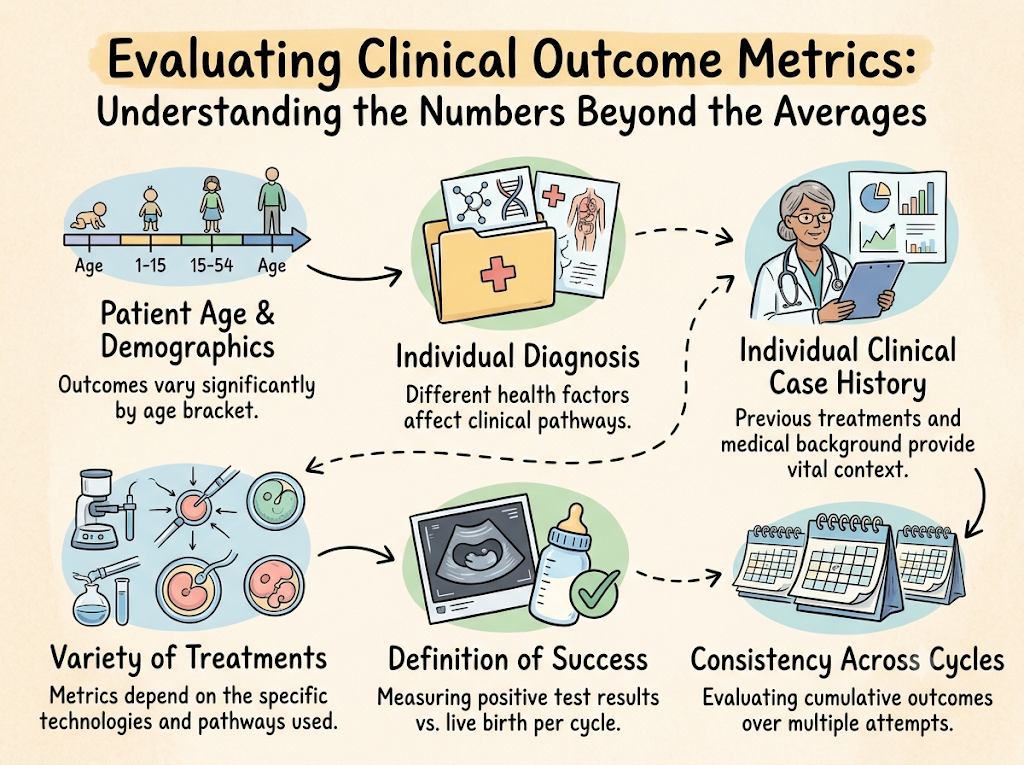
When reviewing published IVF success rates, it is critical to look at the factors that shape those calculations:
- Patient demographics and criteria: Facilities that work with complex diagnoses or patients of advanced reproductive age often report different baseline numbers than those with strict intake criteria.
- Specific outcome measures: Check whether a metric reflects chemical pregnancy, clinical pregnancy via ultrasound, implantation rate, or live birth per intended retrieval versus per transfer.
- Single-cycle versus cumulative data: Cumulative figures reflect outcomes across multiple sequential cycles, whereas single-cycle statistics reflect the results of one isolated attempt.
- Data maturity and reporting periods: National registries require significant time to collect, verify, and publish validated figures. Ensure that the numbers you evaluate come from documented historical reporting periods rather than unverified recent claims.
Registry data provides valuable insight into general activity levels, but only a board-certified reproductive endocrinologist can assess how your personal health history translates into realistic clinical expectations.
Evaluating Clinical Settings with Consistent Criteria
Choosing a medical team should never come down to marketing charisma, unvetted reviews, or subjective internet rankings. Selecting where to receive care calls for a structured review of clinical protocols, laboratory oversight, and operational transparency.
When prospective patients systematically compare fertility clinics, they find it helpful to focus on consistent, objective checkpoints:
- Care continuity: Will you see a primary physician throughout your cycle, or does a rotating team handle monitoring visits and procedures?
- Laboratory quality: Does the facility hold recognized regional or national accreditations, utilize certified cleanroom environments, and maintain dedicated embryology leadership?
- Billing transparency: Does the administrative team offer itemized fee schedules, written explanations of inclusions, and straightforward policies regarding cancelled cycles?
- Patient communication: Are there dedicated cycle coordinators, reliable digital communication channels, and accessible emergency contact procedures?
Systematic research directs your focus toward transparent, communicative IVF clinics that emphasize clear documentation and open dialogue at every stage of care.
Navigating Cross-Border Medical Considerations
As global travel and telecommunications have expanded, an increasing number of individuals consider travelling for IVF abroad. Motives vary considerably: some seek access to donor arrangements or legal frameworks not permitted in their home countries, while others look into regions with lower baseline operating expenses.
When looking into the IVF cost by country, it is vital to balance base procedural rates against the total logistical footprint. Lower procedure fees in another region can be quickly countered by international flights, extended hotel stays, currency exchange rates, translation support, and travel insurance.
Furthermore, international medical care requires close attention to local regulations, legal parentage standards, donor anonymity laws, and clinical continuity. It is essential to confirm how early monitoring will be handled before you travel, how medical records will be transferred, and which local doctor will manage early pregnancy care or potential complications once you return home. Cross-border healthcare demands thorough legal, medical, and practical preparation rather than a quick decision based on an attractive headline price.
Understanding Specialized Laboratory Technologies
Reproductive medicine encompasses various laboratory techniques tailored to specific diagnoses. Learning about these approaches at an educational level helps you have informed conversations with medical professionals without feeling pressured into unneeded add-ons.
For individuals wishing to preserve their reproductive options for medical, personal, or professional reasons, egg freezing offers a standardized fertility-preservation approach. It mirrors the stimulation and retrieval phases of a standard treatment cycle, followed by vitrification to safely preserve unfertilized oocytes for future use.
In cases involving specific male-factor subfertility or previous fertilization barriers, ICSI treatment offers an advanced laboratory fertilization method where a single morphologically selected sperm cell is micro-injected directly into an egg. While highly valuable for specific clinical indications, it is not universally necessary for every patient.
Every additional laboratory intervention carries distinct clinical rationales, trade-offs, and costs. Understanding their intended purposes helps you ask your doctor clear questions about whether an advanced technique is medically indicated in your case.
Exploring the Full Spectrum of Clinical Approaches
Assisted reproductive technology is rarely a one-size-fits-all pathway. Looking across the full spectrum of fertility treatment options—from lifestyle modifications, ovulation induction, and intrauterine insemination (IUI) to advanced micromanipulation and donor-assisted cycles—ensures you do not skip over less invasive alternatives.
Moving straight to intensive procedures without exploring baseline diagnostics can lead to avoidable physical and financial strain. A balanced research approach explores the full range of reproductive medicine, recognizing that the right clinical path depends on thorough diagnostic evaluations, medical guidance, personal comfort, and individual values.
Provider Comparison Table
| Research Factor | What to Check |
| Treatment | Procedures, services, and general process |
| Cost | What is included and what may be separate |
| Outcomes | Source, context, reporting period, and methodology |
| Provider | Clinical information and transparency |
| Location | Access, travel, and follow-up |
| International Care | Regulations, logistics, and total expenses |
Research Workflow
- Define: Identify what you need to understand. Narrow your focus to a specific question, diagnostic step, or clinical concept before beginning a search session.
- Research: Gather information from credible sources. Rely on academic medical centers, established educational platforms, peer-reviewed journals, and regulatory bodies.
- Verify: Check important claims, sources, and dates. Ensure the material is current, medically sourced, and free from misleading marketing guarantees.
- Compare: Evaluate providers or options using consistent criteria. Use standardized points of comparison rather than relying on promotional highlights or isolated reviews.
- Question: Record anything that remains unclear. Write down ambiguous terms, conflicting claims, and fee questions in a central notebook.
- Consult: Discuss personal circumstances with qualified healthcare professionals. Take your organized notes to your consultation so your doctor can evaluate them against your health profile.
- Decide: Make decisions using appropriate medical and practical guidance. Work collaboratively with your clinical team to choose a path that fits your medical needs, financial boundaries, and personal values.
Information-Quality Checklist
- [ ] Check who published the information.
- [ ] Look for credible medical or scientific sources.
- [ ] Check publication and update dates.
- [ ] Distinguish educational information from advertising.
- [ ] Look for context behind statistics.
- [ ] Cross-check important claims.
- [ ] Be cautious with dramatic promises or guarantees.
- [ ] Discuss personal medical decisions with qualified healthcare professionals.
How IVFHospitalsNow.com Fits into the Research Process
Finding organized, dependable reproductive health information without spending hours filtering through marketing pages can be challenging. This is where dedicated educational platforms offer meaningful support. IVFHospitalsNow is an independent fertility-care education, research, and provider-discovery platform designed to help readers navigate assisted reproductive care systematically.
The platform provides structured, educational resources covering fertility treatments, reproductive conditions, diagnostic tests, medications, treatment costs, and outcome reporting contexts. It also helps individuals discover doctors, explore physical clinic locations, research international care considerations, and review clinic-selection guidance using clear, evidence-based frameworks.
Importantly, IVFHospitalsNow functions strictly as an educational and research resource; it is not a medical practice, hospital, clinic, or treating physician. It does not provide medical diagnoses, clinical advice, or individual care plans. Instead, it serves as a practical research companion, helping individuals and couples organize their notes, understand clinical terminology, and prepare clear questions for their medical consultations.
Discussion Questions
- What information do you check first when researching fertility care online?
- Which factors matter most when comparing fertility providers?
- What makes an online healthcare resource feel transparent and useful?
- Which part of fertility-care research is most difficult to understand?
Conclusion
Navigating fertility care online does not have to be an overwhelming process. By taking time to understand the clinical journey before comparing specific options, looking closely at the full picture behind advertised costs, and interpreting outcome statistics with appropriate nuance, you can protect both your emotional energy and financial resources. Evaluating facilities through consistent, objective criteria, weighing the realities of international travel, and learning about available reproductive technologies ensures that your search remains grounded in medical reality.
Online resources should never replace the expertise and diagnostic evaluations of licensed reproductive specialists. However, utilizing independent educational and provider-discovery platforms like IVFHospitalsNow gives you the tools to organize complex clinical topics, cross-check claims, and cut through marketing rhetoric. With a disciplined research workflow and a clear information-quality checklist, you can enter your medical consultations informed, grounded, and ready to make the best decisions for your family-building journey.
Leave a Reply