The Enterprise DevOps Roadmap: From Foundation to Production Reliability

September 29, 2026 · 18 reads
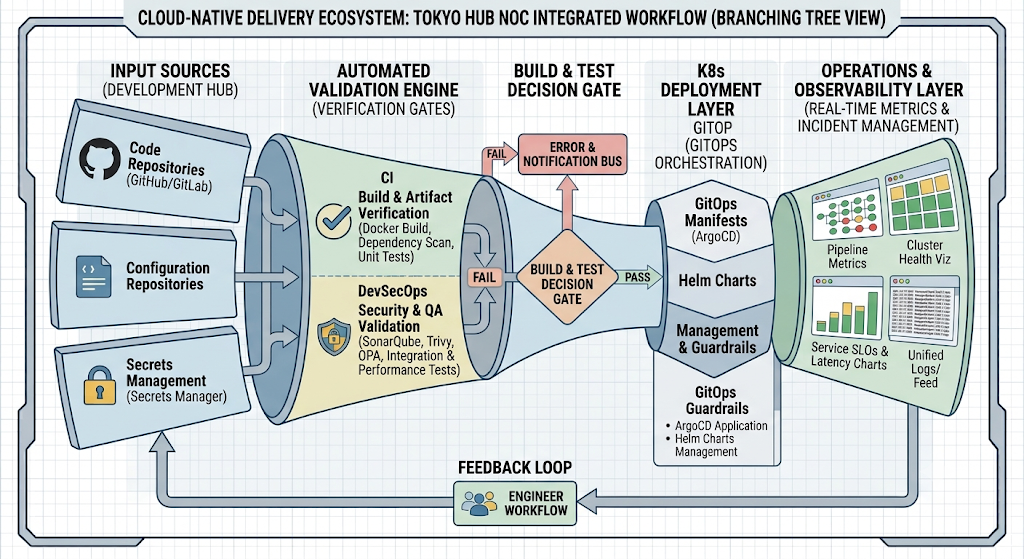
Introduction
Modernizing Software Delivery Beyond Tool Adoption
Many organizations initiate digital transformation programs by adopting modern technical tools: configuring continuous integration engines, provisioning cloud accounts, or containerizing legacy services. Yet, after substantial investment, engineering managers and technical leads often notice that release velocity remains sluggish, handoffs stay error-prone, and deployments continue to provoke anxiety.
The issue is rarely the quality of the software tools themselves. More often, engineering initiatives stall because tools are treated as magic solutions rather than enablers of broader operational practices. When an organization layers modern technology over unexamined manual habits, existing bottlenecks simply move to different stages of the delivery lifecycle.
Common operational hurdles faced by modern technical teams include:
- Manual sign-offs and fragmented handoffs between developers and operations staff
- Discrepancies between staging environments and live production systems
- Infrequent, large-batch releases that increase risk and prolong verification cycles
- Expanding infrastructure complexity that overwhelms traditional system administrators
- Intermittent production outages and prolonged mean time to recovery
- Security audits introduced solely as an eleventh-hour compliance gate
- Talent shortages in cloud-native operational paradigms
- Departmental silos that prevent shared ownership of software delivery
Developing a mature engineering organization requires treating DevOps as an integrated discipline—one that unifies people, workflows, internal skills, automation platforms, and organizational culture. Rather than attempting a sweeping overnight change, engineering teams achieve sustainable results by building capability incrementally.
Assessing Existing Engineering Capabilities
Before introducing new platforms or restructuring engineering teams, an organization must establish a transparent baseline of its current technical practices. Adopting tools without a clear diagnosis often amplifies inefficiencies rather than eliminating them.
To understand their current maturity, engineering leaders should evaluate several foundational dimensions:
- Deployment workflows: How many discrete manual approvals are required between code completion and production deployment?
- Infrastructure management: Are server resources configured via ad-hoc web dashboards or defined deterministically in version control?
- Automation levels: Does the test suite run automatically on every pull request, or do teams rely on scheduled manual regression testing?
- Monitoring and observability: Do monitoring systems provide actionable insights into user experience, or are engineers inundated with noisy, unactionable alerts?
- Incident response: Does the organization conduct blameless post-mortems focused on system resilience, or do reviews focus on human error?
- Security protocols: When are dependencies, container layers, and configurations checked for security flaws?
- Team responsibilities: Do development and operations teams share operational feedback, or does one team simply hand off code for the other to maintain?
- Existing technical skills: Does the current team have hands-on experience operating distributed systems in production?
Clarifying these operational realities helps technology leaders identify practical bottlenecks and direct engineering investments where they yield measurable operational stability.
Cloud-Native Engineering and Scalable Delivery
Cloud-native architecture provides the modularity and elasticity needed for rapid, reliable software delivery. Packaging applications and their dependencies into standardized containers eliminates environment inconsistencies between local development machines and production clusters.
However, running containerized workloads in enterprise production environments introduces operational challenges. While container orchestration platforms handle horizontal scaling, self-healing, and service discovery, they also require operational mastery of cluster networking, ingress routing, namespace isolation, resource quotas, and zero-downtime rolling updates. Teams that deploy container orchestrators without sufficient operational preparation often encounter platform instability and configuration sprawl.
Structured technical education, such as a focused Kubernetes 研修, helps engineering teams understand cluster internals, pod scheduling mechanics, persistent storage management, and cluster observability. Developing this internal competency ensures that container orchestration delivers actual operational agility rather than unnecessary administrative overhead.
Infrastructure as Code for Repeatable Environments
Relying on manual server provisioning, undocumented setup scripts, or cloud console adjustments inevitably leads to configuration drift. In such environments, staging servers diverge from production baselines, turning routine deployments into unpredictable operational events.
Infrastructure as Code (IaC) applies software development discipline—such as centralized version control, peer reviews, automated linting, and automated testing—to physical and cloud infrastructure.
Key benefits of managing infrastructure as code include:
- Reproducible environments: Enabling teams to spin up temporary testing environments that replicate production topologies.
- Versioned change history: Creating an auditable record of every configuration change, showing who modified a resource and why.
- Configuration consistency: Eliminating manual, ad-hoc changes that cause runtime drift across environments.
- Collaborative infrastructure workflows: Allowing software developers and platform engineers to review and update infrastructure using familiar pull-request models.
Because multi-cloud adoption is standard across Japanese enterprises, mastering declarative provisioning tools is essential. Enrolling platform engineers and system administrators in an in-depth Terraform 研修 enables them to build modular configuration libraries, manage remote state backends safely, and incorporate automated infrastructure linting directly into CI/CD pipelines.
Reliability Engineering as an Operational Discipline
Accelerating software delivery creates little business value if live systems suffer frequent downtime or performance degradation. Site Reliability Engineering (SRE) bridges software development and system administration by treating operational challenges as engineering problems.
A mature reliability practice introduces several foundational concepts:
- Service-Level Indicators (SLIs) and Service-Level Objectives (SLOs): Quantifiable metrics, such as endpoint latency percentiles and error rates, that reflect true user experience.
- Error budgets: Objective data points that help product and platform teams balance rapid feature delivery with platform stability.
- Proactive capacity planning: Analyzing operational trends to forecast compute, memory, and database requirements before resource limits are hit.
- Reliability automation: Developing self-healing routines, automated circuit breakers, and graceful fallback behaviors.
- Blameless post-mortems: Conducting structured incident investigations to identify architectural weaknesses rather than human mistakes.
Adopting these practices requires both technical skills and a mindset shift toward measurable service health. Providing engineering groups with a practical SRE 研修 gives teams hands-on experience instrumenting distributed applications, defining meaningful service objectives, and implementing automation that safeguards system uptime.
Integrating Security Across the Delivery Lifecycle
In rapid continuous-delivery workflows, traditional security audits conducted immediately before production deployment create painful operational bottlenecks. When security reviews occur only at the end of a sprint, identifying an architectural flaw or an unpatched package forces costly delays and rework.
DevSecOps embeds security checks directly into daily engineering activities, shifting verification earlier into the delivery cycle:
- Automated dependency auditing: Scanning open-source libraries for known vulnerabilities during daily builds and pull requests.
- Static application security testing (SAST): Analyzing source code for security vulnerabilities, unsafe memory handling, or injection flaws at commit time.
- Container image validation: Scanning base operating system layers and application dependencies for critical vulnerabilities before images reach production registries.
- Centralized secrets management: Storing credentials, database tokens, and encryption keys in secured vaults rather than in source code files.
- Policy as code: Programmatically validating cloud resource configurations against enterprise security standards before deployment.
Equipping developers and infrastructure staff with a comprehensive DevSecOps 研修 helps organizations build automated compliance pipelines, address vulnerabilities during regular development sprints, and maintain compliance standards without stalling delivery cadence.
Extending Delivery Practices to Machine Learning
As organizations deploy predictive models and artificial intelligence into production systems, engineering teams encounter operational requirements that standard software delivery workflows cannot address alone. Machine learning platforms depend not only on code quality, but also on dataset integrity, feature pipelines, training hardware, and runtime inference performance.
Managing production machine learning systems requires specialized operational capabilities:
- Data pipeline lineage: Ensuring training datasets and data transformation steps are clean, tracked, and fully reproducible.
- Experiment and model tracking: Recording training hyperparameters, source code versions, and evaluation metrics in a centralized model registry.
- Automated model evaluation: Verifying model accuracy, inference latency, and bias metrics before deploying artifacts to production.
- Inference drift monitoring: Tracking production requests to detect data drift and concept drift when live inputs diverge from training distributions.
- Automated retraining pipelines: Updating and deploying models systematically as fresh data becomes available.
To help data scientists and systems engineers establish reliable machine learning workflows, participating in a targeted MLOps 研修 provides practical experience in standardizing data pipelines, tracking model artifacts, and deploying scalable inference endpoints.
Structuring Training, Advisory, and Technical Support
Enterprise organizations differ significantly in their existing technical background, legacy system architecture, and operational goals. Consequently, the external expertise required to accelerate engineering capabilities will vary depending on current organizational needs.
Organizations often combine several engagement models to support their internal goals:
- Internal capability development: Upskilling existing employees ensures institutional knowledge remains within the company. Participating in structured DevOps 研修 programs equips engineering teams with practical, hands-on skills tailored to modern enterprise workflows. For larger organizations seeking coordinated education across distributed squads, engaging in DevOps corporate training Japan establishes a consistent engineering baseline across business units.
- Strategic architecture consulting: When designing modern delivery platforms or untangling complex legacy architectures, collaborating with an experienced DevOps consultant Japan provides an objective evaluation of existing processes, architecture, and toolchains.
- Comprehensive operational modernization: Organizations seeking strategic direction benefit from focused DevOps コンサルティング to establish transformation roadmaps, define platform engineering principles, and design resilient operational workflows.
- Engineering implementation assistance: When internal engineering bandwidth is constrained, hands-on implementation specialists work directly with team members to build automated pipelines, configure container clusters, and write modular infrastructure definitions.
- Ongoing operational support: Long-term engineering modernization benefits from flexible DevOps support Japan services, giving internal teams direct access to architectural reviews, operational advisories, and technical troubleshooting as platforms evolve.
A Practical Roadmap for Capability Building
Transforming engineering practices across an enterprise is an iterative journey that works best when approached in clear stages rather than an all-at-once migration:
- Assess: Audit current software delivery workflows, deployment cadences, manual handoffs, infrastructure configurations, and incident histories. Identify the primary bottlenecks slowing down engineering throughput.
- Prioritize: Choose one high-friction area or a representative pilot project rather than attempting to re-architect all enterprise systems at once. Focus on improvements that deliver clear, measurable engineering value, such as standardizing build pipelines or automating staging deployments.
- Learn: Ensure participating engineers understand the core principles, declarative patterns, and operational demands of the technologies being introduced before implementing platforms in production.
- Implement: Apply declarative infrastructure, standardized deployment pipelines, container orchestration, and automated observability to the chosen pilot workload.
- Measure: Track core engineering metrics, such as deployment frequency, lead time for changes, change failure rate, and mean time to restore service, to objectively evaluate platform performance.
- Improve: Use insights from production deployments, blameless post-mortems, and developer feedback to refine pipelines, address emerging bottlenecks, and gradually expand modern practices across additional engineering squads.
Practical Capability Checklist
Use this checklist to evaluate your organization’s current engineering capabilities and prioritize improvement areas:
- [ ] Are deployments repeatable? Software releases are automated via pipelines and do not require manual SSH sessions or custom manual commands on production servers.
- [ ] Is infrastructure version controlled? Cloud resources, network routes, and security groups are codified in declarative files and reviewed via pull requests.
- [ ] Are manual tasks being automated? Repetitive maintenance activities, database backups, and certificate rotations are executed via scheduled automation.
- [ ] Are environments consistent? Development, staging, and production environments share identical architectural patterns, reducing configuration drift.
- [ ] Is observability available? Application metrics, structured logs, and distributed traces allow engineers to understand runtime behavior and pinpoint failures quickly.
- [ ] Are incidents documented and reviewed? Production disruptions lead to blameless reviews that produce tangible architectural and procedural improvements.
- [ ] Are security checks integrated? Dependency vulnerability scanning, container image audits, and static code analyses run automatically during daily builds.
- [ ] Are secrets managed securely? Application credentials, API tokens, and encryption keys are retrieved dynamically from audited secret vaults.
- [ ] Are reliability objectives defined? Engineering teams and business stakeholders have established agreed-upon SLIs and SLOs for critical user paths.
- [ ] Do engineers have the required technical skills? Staff members receive structured, hands-on training on the cloud-native platforms they are expected to operate.
Technology Enablement Through DevOpsSchool.jp
Building resilient engineering capabilities requires practical, real-world instruction rather than abstract overviews. DevOpsSchool.jp is a Japan-focused platform dedicated to technology training, corporate education, advisory consulting, hands-on implementation assistance, and professional technical support.
The platform assists Japanese enterprises, engineering leads, and technology teams in navigating the complex challenges discussed throughout this guide, focusing on core engineering disciplines:
- Modern DevOps methodologies, continuous delivery pipelines, and software release automation
- Cloud-native engineering, container orchestration, and Kubernetes cluster operations
- Declarative Infrastructure as Code using Terraform and multi-cloud provisioning patterns
- Site Reliability Engineering, observability systems, and incident response frameworks
- DevSecOps integration, automated pipeline security checks, and policy enforcement
- MLOps architecture, reproducible data pipelines, and machine learning lifecycle management
Whether an enterprise requires corporate training to upskill internal staff, advisory consulting to structure platform architecture, hands-on implementation support, or ongoing technical guidance, DevOpsSchool.jp provides practical enablement designed to help organizations build lasting, in-house technical excellence.
Frequently Asked Questions
How can an organization measure whether its DevOps capability-building efforts are working?
Progress is best evaluated through objective operational metrics rather than subjective milestones. Widely recognized delivery indicators include deployment frequency, lead time for changes, change failure rate, and mean time to restore service. Improvement across these metrics indicates that automation, testing, and operational workflows are functioning smoothly.
Why is internal capability building usually more sustainable than permanent outsourcing?
While external contractors can assist during initial migrations or acute skill shortages, internal staff possess the deep contextual knowledge of business rules, system dependencies, and organizational history. Equipping internal engineers with modern cloud-native and automation skills ensures that the company retains full ownership and operational responsiveness over its core platforms.
What is the most effective way to introduce DevSecOps without slowing down developer velocity?
DevSecOps works best when security tools are integrated directly into developer workflows as automated feedback loops. Rather than blocking deployments with complex, opaque reports, teams should start with fast static analysis and dependency scanning on pull requests, providing clear, actionable remediation guidance directly within the developer’s normal code review interface.
Can an enterprise adopt Site Reliability Engineering principles if its core systems are legacy applications?
Yes. SRE principles such as Service-Level Objectives, error budgets, and blameless post-mortems do not depend on modern microservices. Measuring application availability from the user’s perspective and using error budgets to balance stability and feature work can be implemented across traditional monolithic applications and hosted infrastructure.
Conclusion
Building modern engineering capabilities is an ongoing operational commitment rather than a one-time technology rollout. By assessing existing workflows, building strong cloud-native skills, managing infrastructure with declarative code, embedding reliability principles, shifting security into daily development, and operationalizing machine learning workloads, organizations across Japan can establish a resilient, highly responsive engineering culture.
While software tools and cloud architectures will continue to evolve, investing in internal technical skills, practical automation, and collaborative workflows provides an enduring operational foundation. For Japanese enterprises seeking practical training, strategic consulting, implementation assistance, and continuous technical support along this path, DevOpsSchool.jp serves as a dedicated resource for building modern engineering capabilities.
Leave a Reply