Navigating Fertility Care Online: A Practical Guide to Research, Costs, and Clinics

September 26, 2026 · 15 reads
Introduction
Starting to research fertility care on the internet can feel overwhelming within minutes. A single search produces hundreds of medical definitions, varying price estimates, promotional clinic claims, and statistics that seem impossible to cross-reference. Because reproductive medicine involves complex biology, emotional vulnerability, and significant financial commitments, sorting through online claims requires a calm, structured approach.
Whether you are exploring family-building paths, trying to understand diagnostic testing, or seeking to compare IVF clinics, knowing what details to look for makes the entire journey clearer. Independent educational platforms like IVFHospitalsNow.com serve as valuable reference points for understanding general procedures, provider considerations, and regional differences before you sit down with a physician.
Exploring Common Fertility Treatment Options
Before evaluating providers, it helps to understand the baseline procedures commonly discussed across medical literature. Fertility care encompasses a wide spectrum of interventions, ranging from baseline health diagnostics to advanced assisted reproductive technology (ART).
- Fertility Testing: Initial evaluations for all partners, including hormone blood panels (such as AMH and FSH), pelvic ultrasound imaging, ovarian reserve assessments, and comprehensive semen analyses.
- Intrauterine Insemination (IUI): Often described as artificial insemination, this involves placing concentrated, washed sperm directly into the uterus around ovulation, sometimes accompanied by mild ovarian stimulation medication.
- In Vitro Fertilization (IVF): An ART procedure where ovaries are stimulated with hormone injections to produce multiple mature eggs. These are retrieved surgically, fertilized with sperm in an embryology laboratory, monitored as embryos develop, and later transferred back into the uterus.
- Egg Freezing: An elective or medically indicated preservation process where unfertilized mature eggs are retrieved and vitrified (rapidly frozen) for future family-building cycles.
Understanding available fertility treatment options gives you a solid foundation, allowing you to ask precise questions when reviewing clinic materials.
Understanding ICSI vs IVF
When reading about in vitro fertilization protocols, you will frequently see Intracytoplasmic Sperm Injection mentioned alongside conventional fertilization. Understanding ICSI vs IVF comes down to how fertilization takes place inside the laboratory.
In standard in vitro fertilization, retrieved eggs are placed in a specialized culture dish surrounded by tens of thousands of active sperm cells, allowing natural selection and penetration to occur overnight.
In contrast, ICSI is an advanced micromanipulation technique. An embryologist selects a single, structurally normal sperm cell under high magnification and injects it directly into the cytoplasm of a mature egg using a fine glass needle.
Clinicians often recommend ICSI when managing severe male-factor infertility (such as low count, poor motility, or abnormal morphology), previous low fertilization rates during a standard cycle, or when utilizing surgically retrieved sperm. Neither approach is universally superior; the appropriate protocol depends entirely on individual diagnostic findings determined by a medical team.
How to Compare IVF Clinics
Fertility providers differ significantly in size, medical philosophy, laboratory sophistication, and transparency. To compare IVF clinics effectively, focus on objective, verifiable components rather than marketing slogans:
- Treatments and Subspecialties: Confirm whether the facility manages complex cases relevant to your medical history, such as recurrent implantation failure, PCOS, severe endometriosis, or diminished ovarian reserve.
- Provider Credentials: Check the qualifications, board certifications, and specialized training of the reproductive endocrinologists and clinical team.
- Laboratory Operations: Inquire whether the embryology lab operates on-site, maintains rigorous clean-room standards, holds proper accreditations, and operates seven days a week to handle retrievals and transfers at optimal biological times.
- Billing and Bundling Clarity: Request a line-item fee schedule distinguishing core medical packages from optional add-ons, medications, and laboratory procedures.
- Communication and Continuity: Clarify who handles day-to-day questions—whether you speak primarily with a dedicated coordinator, nursing team, or physician.
Independent informational portals such as IVFHospitalsNow.com provide structured educational frameworks that help patients identify key operational metrics before booking introductory consultations.
Evaluating Local Options: Finding IVF Clinics Near Me
When starting your search locally, geographic proximity often feels like the primary priority. Frequent monitoring appointments—requiring bloodwork and transvaginal ultrasounds every few days during ovarian stimulation—make location genuinely important.
However, selecting from available IVF clinics near me should involve balanced consideration. A clinic five minutes away may not possess the specialized laboratory equipment or donor protocols that a center forty-five minutes away maintains.
When evaluating nearby centers, confirm their appointment scheduling flexibility for early morning monitoring, the presence of on-site diagnostic testing to ensure rapid bloodwork turnarounds, and how emergency or weekend inquiries are escalated to clinical staff. Proximity adds convenience, but clinical alignment with your specific diagnostic profile remains paramount.
Deconstructing IVF Treatment Cost
One of the most complex aspects of fertility research is untangling the full financial picture. A headline package price frequently covers only a subset of the clinical steps required for a complete cycle.
Total IVF Investment = Base Clinical Fees + Variable Prescriptions + Diagnostics + Lab Procedures + Cryopreservation
A comprehensive review of IVF treatment cost accounts for multiple phases:
- Pre-Cycle Diagnostics: Initial screening blood panels, infectious disease screenings, genetic carrier panels, and uterine evaluations (such as saline infusion sonograms or hysteroscopies).
- Medications: Injectable gonadotropins, ovulation suppressants, and trigger injections are almost always billed through specialty pharmacies separately from clinic fees.
- Cycle Monitoring: Clinic visits, serial ultrasound imaging, and hormone tracking throughout active stimulation.
- Surgical and Anesthesia Services: Physician retrieval fees, operating facility use, and certified anesthesiologist charges.
- Embryology Laboratory Fees: Fertilization handling, blastocyst culture, assisted hatching, and biopsy for preimplantation genetic testing (PGT) if utilized.
- Cryopreservation and Maintenance: Initial vitrification of surplus embryos, alongside ongoing recurring monthly or annual storage fees.
- Transfers and Follow-Up: Frozen embryo transfer (FET) preparation, post-transfer blood pregnancy tests, and early pregnancy ultrasound monitoring.
Because treatment expenses vary widely based on diagnostic needs and cycle designs, research resources like IVFHospitalsNow.com help readers organize these cost categories systematically to avoid surprise bills.
Considering IVF Treatment Abroad
Cross-border reproductive care—traveling internationally for medical services—has become an established consideration for patients seeking specific legal frameworks, third-party options, or different healthcare price structures. However, exploring IVF treatment abroad requires thorough preparation:
- Regulatory Landscapes: Reproductive laws differ across borders. Regulations govern donor anonymity, access for single parents or same-sex couples, genetic testing permissions, and the maximum number of embryos allowed per transfer.
- Timeline and Logistical Feasibility: Protocols often require staying near the international center for two to three weeks, or coordinating local cycle monitoring in your home country before flying abroad for retrieval and transfer.
- Medical Documentation Continuity: Ensure your medical files, treatment protocols, embryology summaries, and surgical notes can be translated and transferred smoothly between your local general practitioner and the overseas clinic.
- Post-Procedure Care: Confirm an established plan for monitoring early pregnancy or managing rare complications (such as ovarian hyperstimulation syndrome) once you return home.
Healthcare systems vary widely, and no country is universally optimal for every patient. Thorough research into foreign clinical standards and accreditation bodies is essential.
A Realistic Look at IVF Cost by Country
Comparing an IVF cost by country framework requires looking far beyond the published base medical rates. While clinical procedure fees may be lower in certain regions, total out-of-pocket spending includes secondary logistical elements:
| Expense Category | Local Care Considerations | International Care Considerations |
| Base Clinical Fee | Standard domestic tariff structures | Often adjusted for foreign medical visitors |
| Medications | Domestic insurance or pharmacy pricing | May require local purchase or import clearances |
| Travel & Lodging | Daily commuting or fuel costs | Flights, lodging for 2–3 weeks, local transport, meals |
| Diagnostics | Routine local lab network access | Out-of-pocket costs for home monitoring before departure |
| Follow-Up Services | Integrated with the primary doctor | Managed independently through local urgent care or OB/GYN |
Currency conversion fluctuations, international banking fees, visa costs, and repeat travel for frozen transfers can significantly affect total expenditures. Reviewing comparative guides on platforms like IVFHospitalsNow.com can help you account for indirect expenses before committing to travel plans.
Interpreting IVF Success Rates Accurately
Success data published on clinic websites must always be evaluated within context. High percentages presented without qualification can be misleading, as reproductive outcomes are heavily shaped by patient demographics.
When reviewing IVF success rates, keep these clinical factors in mind:
- Patient Age: Oocyte quality and quantity decline naturally with age. Data must always be stratified by specific age brackets (e.g., under 35, 35–37, 38–40, 41–42, and over 42).
- Denominator Definitions: Pay close attention to what the percentage measures. A rate calculated per embryo transfer is higher than a rate calculated per retrieval cycle initiated, because some cycles are canceled before reaching the transfer stage.
- Live Birth vs. Pregnancy: A positive pregnancy test (biochemical pregnancy) or ultrasound visualization of a gestational sac (clinical pregnancy) does not always culminate in a live birth. Live-birth rates per cycle started provide the clearest picture.
- Patient Selection Criteria: Some centers accept complex cases, older patients, or individuals with multiple previous failed cycles, which naturally lowers their overall statistical averages. Other clinics maintain stricter admission criteria that keep numbers higher.
- Cumulative Rates: Many clinics report cumulative success across multiple retrieval and transfer cycles rather than a single attempt.
Official regulatory bodies—such as SART or the CDC in the United States, HFEA in the UK, or ESHRE across Europe—compile standardized clinical datasets that offer objective baselines free of marketing adjustments.
Breaking Down Egg Freezing Cost
Elective oocyte cryopreservation is increasingly common for individuals preserving fertility options for personal, social, or medical reasons. Like full IVF cycles, the overall egg freezing cost involves multiple operational layers.
A full assessment includes initial diagnostic reserve testing, several weeks of hormonal stimulation prescriptions, continuous ultrasound and blood monitoring, outpatient surgical retrieval under anesthesia, and specialized vitrification processing by laboratory staff.
Crucially, ongoing maintenance requires annual storage fees for the frozen oocytes, which continue until they are either used or discarded. When planning long-term preservation, you must also consider the future costs of thawing, ICSI fertilization, embryo culture, and uterine transfer procedures whenever you choose to use those eggs later in life.
Evaluating Fertility Information Online
Because medical claims online can be outdated, promotional, or unvetted, verifying the sources of your health reading is critical:
- Authorship and Review: Check whether articles cite board-certified reproductive endocrinologists, embryologists, or credible academic research institutions.
- Publication Dates: Reproductive technologies, lab protocols, and legal frameworks change regularly. Look for content published or updated within the last two to three years.
- Transparency of Intent: Distinguish between purely educational guides and promotional clinic websites designed to funnel patients toward specific service packages.
- References and Study Citations: Trustworthy resources link directly to peer-reviewed studies (such as those in Fertility and Sterility or Human Reproduction) and standardized registry data.
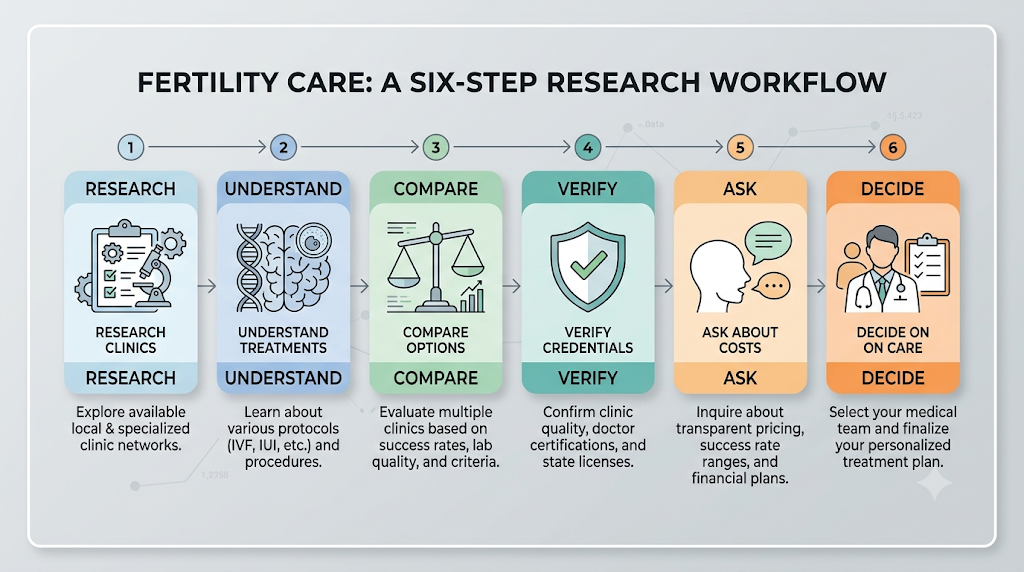
A Simple Fertility Research Workflow
To prevent research fatigue, approach your online reading using this six-step framework:
- Research: Learn standard reproductive anatomy, diagnostic testing vocabulary, and general procedural basics.
- Understand: Familiarize yourself with the physiological rationales behind different fertility treatment options and lab procedures.
- Compare: Use independent directories and platforms like IVFHospitalsNow.com to review clinical models, fee structures, and services.
- Verify: Check national registry databases, doctor licensing boards, and clinic laboratory accreditations.
- Ask: Compile focused, written questions regarding lab protocols, package exclusions, and contingency plans for your consultations.
- Decide: Select a fertility provider based on medical expertise, transparent communication, and your personal comfort level.
Practical Provider Research Checklist
Take this checklist with you when reviewing clinical materials or attending preliminary consultations:
- [ ] Are the primary physicians board-certified in Reproductive Endocrinology and Infertility (REI)?
- [ ] Is the embryology laboratory accredited by recognized national standards bodies, and is it located on-site?
- [ ] Does the center handle specialized procedures (such as PGT-A, ICSI, and donor cycles) directly?
- [ ] Does the clinic provide a fully itemized cost breakdown distinguishing medications, anesthesia, and storage?
- [ ] Are reporting practices aligned with national regulatory standards?
- [ ] What are the specific contingency protocols if a cycle yields poor stimulation or fails to produce viable blastocysts?
- [ ] How are off-hours monitoring, weekend retrievals, and urgent patient questions managed?
Frequently Asked Questions
How should I compare IVF clinics?
To compare IVF clinics effectively, look beyond headline advertising. Examine physician credentials, on-site embryology laboratory accreditations, treatment specializations, itemized pricing transparency, and communication practices. Independent resources like IVFHospitalsNow.com can help you benchmark clinical criteria across different centers.
What factors affect IVF treatment cost?
Overall IVF treatment cost depends on individual medication requirements, required diagnostic panels, embryology laboratory procedures (such as ICSI or genetic testing), anesthesia fees, and ongoing cryopreservation storage expenses.
How should I interpret IVF success rates?
Always evaluate IVF success rates relative to patient age, underlying diagnostic factors, and specific definitions of success (such as live births per cycle initiated versus pregnancies per embryo transfer).
What should I consider before choosing IVF treatment abroad?
Before committing to IVF treatment abroad, examine the host country’s legal frameworks regarding ART, cross-border medical record coordination, total travel timelines, and arrangements for follow-up care once you return home.
How can IVF cost by country be compared fairly?
A fair assessment of IVF cost by country must factor in non-medical travel, extended accommodations, translation requirements, pre-travel local diagnostics, currency exchange rates, and potential repeat visits.
What is the difference between ICSI vs IVF?
In standard IVF, sperm and eggs are combined in a laboratory dish for natural fertilization. In the ICSI vs IVF comparison, ICSI involves an embryologist directly injecting a single selected sperm into an egg, which is commonly utilized in cases of male-factor infertility.
What factors affect egg freezing cost?
The total egg freezing cost includes pre-cycle diagnostic reserve testing, stimulation medications, surgical retrieval procedures, anesthesia, embryology vitrification fees, and recurring annual storage costs.
Conclusion
Navigating fertility care online requires balancing hope with objective due diligence, as marketing narratives and standalone statistics rarely capture the full clinical picture. By approaching your research with a clear framework—understanding foundational procedures, deconstructing all hidden costs, verifying laboratory standards, and interpreting success rates through the lens of individual medical circumstances—you transform an overwhelming process into a manageable, empowering plan. Independent educational resources such as IVFHospitalsNow.com can help guide your preliminary inquiries and highlight key questions, but the most critical step remains partnering with a qualified reproductive specialist who can translate general information into a safe, personalized care pathway tailored to your family-building goals.
Leave a Reply